


Every internal-comms tool you have ever bought has shown you an open-rate dashboard. The number is always reassuring. 60%. 72%. 81% if you A/B-tested the subject line.
It is the wrong number.
When the CEO sends a Friday-afternoon email about a reorg, the question is not whether the company's mail server delivered it. The question is whether the people in that reorg actually read and understood what was said. Those are different things, and the gap between them is where most internal communication quietly fails.
What "open rate" actually measures
Open rate, in email parlance, is the share of recipients whose mail client loaded the tracking pixel embedded in the message. It is a proxy for whether the email was rendered on a screen for long enough for an image to download.
It does not measure attention. It does not measure comprehension. It does not measure recall. It does not even measure scrolling past the preheader. A preview-pane render fires the pixel; iOS Mail Privacy Protection fires the pixel on every email regardless of behaviour; many corporate gateways pre-fetch images and credit every email with an open.
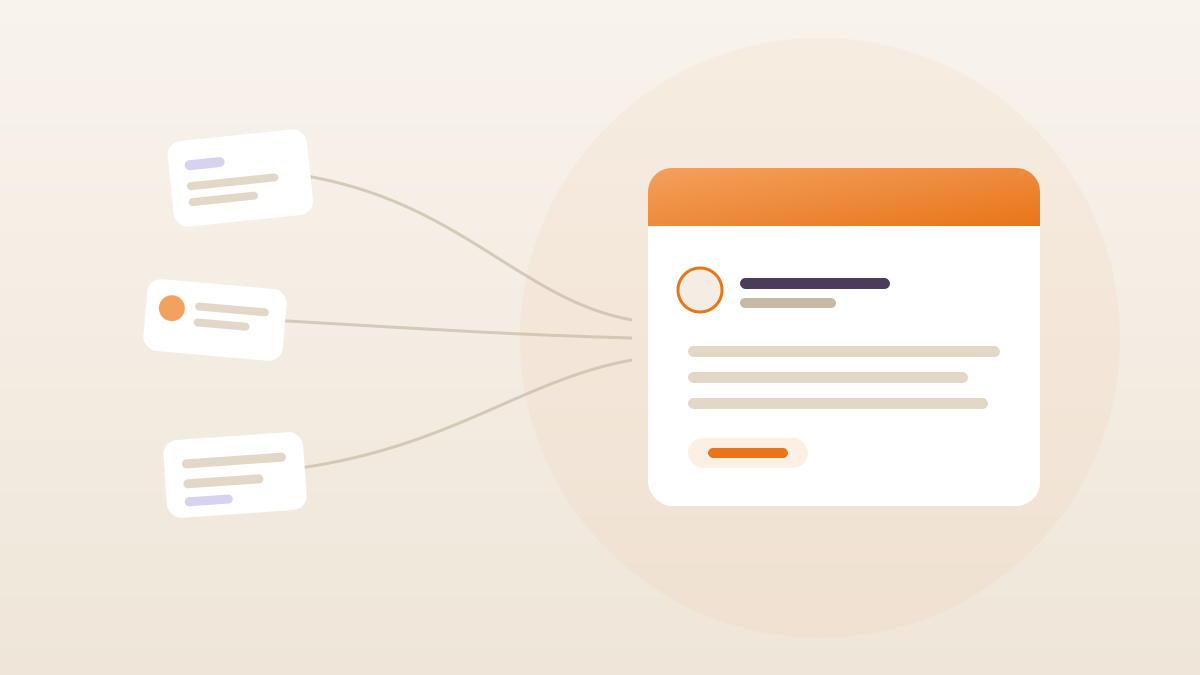
So the open rate flatters you twice: once by counting renders as reads, and once by counting machine pre-fetches as renders. Across benchmarks, internal email shows a ~67% open rate but only a ~6–7% click-through (ContactMonkey, 2025 Internal Email Benchmark Report). The open fires when the message renders; the click is the first sign anyone did anything with it. The distance between those two numbers is the distance between "delivered" and "engaged."
This is not a critique of the people receiving the messages. It is a description of how modern attention works. A typical mid-market knowledge worker now processes well over a hundred work emails a day. The cognitive math does not allow for sustained attention on any one of them.
The three things that actually have to happen
For an internal message to do what leadership intended, three things have to be true. The reader has to:
- See it. The message reached their inbox or feed and was not buried under noise.
- Read it. They actually parsed the content, not just scanned the preheader.
- Acknowledge it. They confirmed, to themselves or to the organisation, that they understood the part that mattered.
An open-rate dashboard tells you about step 1 with low confidence. It tells you nothing about steps 2 or 3. Yet steps 2 and 3 are the entire point of internal communication.
The fix is not better subject lines. The fix is structural: redesign the message so the reader has to do something to clear it. Not because you want to surveil them. Because the act of doing something is the moment you actually have their attention.
Acknowledgment as a structural primitive
The shift that internal-comms teams in 2026 are making is treating acknowledgment as a first-class structural element of important messages, not an optional follow-up survey.
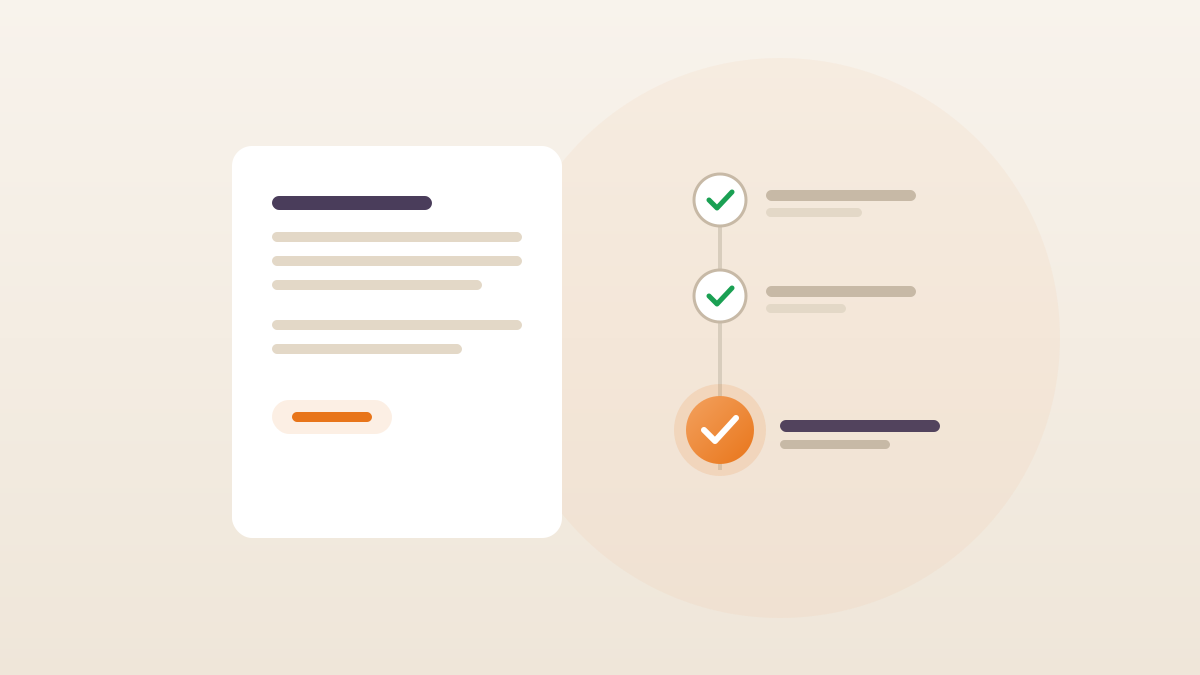
In practice that means: when you publish a high-priority announcement, the reader sees the message and a clearly-labelled "Acknowledge" button. They cannot dismiss the announcement from their feed until they click it. The system records who clicked, when they clicked, and what they were told at the time they clicked.
That last detail matters. If the announcement is later edited, the acknowledgment ties to the version the employee saw, not the current version. Compliance auditors care about this distinction; so should you.
What the data looks like when you do this
Companies that adopt acknowledgment-tracked announcements for high-priority messages typically see three changes in their internal-comms dashboards within the first 90 days:
Read time on important messages goes up. Not dramatically, usually from a baseline of a few seconds (a scan) to the better part of a minute (an actual read). That is the difference between "noticed the announcement" and "processed the announcement."
Acknowledgment rates on critical content stabilise high. Not because compliance suddenly became fashionable, but because the structural friction of having to click "Acknowledge" makes people stop and read first.
Follow-up "I didn't know about that" exceptions drop sharply. This is the actual ROI. The people who used to send "wait, when was this decided?" emails to leadership instead see the announcement, acknowledge it, and move on.
The lever that closes the gap is acknowledgment itself. When a message requires a deliberate "I've read this," you replace a passive open with an active confirmation. And you finally have a number that means what open rate only pretends to. That is the signal internal-comms teams should be optimising for, not open rate.
Where acknowledgment goes wrong
Two failure modes worth naming.
Acknowledgment fatigue. If every Tuesday status update requires an acknowledgment click, employees will start clicking through them as fast as they appear and the structural friction stops doing its job. The fix is discipline on the publishing side: reserve mandatory-acknowledgment for messages where you would care, six months from now, whether the employee saw it. A reorg, a policy change, a safety incident: yes. A monthly newsletter: no.
Acknowledgment as surveillance. Some organisations roll out acknowledgment tracking with the framing "we now know who has and hasn't read the rules." That framing produces resentment, not compliance. The framing that actually works is "we no longer need to send the same email three times because we can see who already saw it the first time." Employees feel less spammed, not more watched.
What this looks like in practice
Picture a 240-person engineering company running its internal comms on a mix of email, a chat tool's #announcements channel, and a wiki page. It cannot answer the question "who has read the new on-call rotation policy" without DMing every engineer.
Move high-priority messages to a structured-announcement format with required acknowledgment, and the head of engineering can pull up the policy's acknowledgment dashboard, see that 232 of 240 engineers have confirmed they read it, and DM the eight who have not, with the exact timestamp of when the policy was published. The whole question goes from "we sent an email and hope" to "we have a list."
That dashboard is what structured announcements with acknowledgment tracking deliver. It is not a magic improvement to attention. Humans are still humans. It is a structural acknowledgment (no pun) that "we sent it" is the wrong answer to "did they get it," and that internal-comms teams need a better one.
The shift
Open rate was a useful metric in 2010 when internal comms meant a weekly newsletter and the question was whether the HTML rendered. It is a vanity metric in 2026, because the underlying problem moved. The new problem is signal in a noisy feed, not delivery.
Acknowledgment tracking does not solve the noise problem. But it does give leadership a defensible, auditable answer to the question that actually matters: did the people who needed to know, know?
If you cannot answer that today, you do not have an attention problem. You have a measurement problem. And measurement problems are fixable.
See how acknowledgment tracking works in Kayden Connect →