

The "engagement score" that comes out of your annual employee survey is not a measurement of engagement. It is a measurement of whether people who filled in your annual employee survey said they were engaged. Those are different things, and treating them as the same is the central mistake that makes most engagement programmes feel theatre-adjacent.
This is not a critique of HR. The annual engagement survey is the best tool the industry had for two decades. The reason to retire it as the headline metric in 2026 is not that it was wrong. It is that the underlying mechanisms now allow for something better, and the something-better turns out to be operationally useful in a way the annual score never was.
What the annual score actually measures
A typical annual engagement survey produces a number between 1 and 100 (or 1 and 5, or 1 and 10, depending on the vendor) by:
- Surveying employees on 40-60 Likert-scale questions.
- Receiving responses from somewhere between 35% and 70% of the workforce.
- Aggregating the responses into a composite using a weighting formula derived from the vendor's benchmarking corpus.
- Reporting the composite as a single headline number.
There are three things wrong with this as an operational metric. None of them are fatal, individually. Cumulatively, they are why the engagement-score slide in the quarterly board pack stops moving CEOs.
It is slow. The annual cadence means the metric reflects, at best, the average sentiment of the previous 12 months. By the time the score has moved, the reasons it moved have changed.
It is sampled. The 35-70% response rate is not random sampling. The people who fill in the survey are systematically the people who feel some way (good or bad) about the company. The silent middle, which is where most attrition risk sits, is under-represented.
It is aggregated. A single company-wide number averages away the only level that actually moves engagement: the team. Gallup's State of the Global Workplace puts global engagement at about 21%, and finds that managers account for roughly 70% of the variance in team engagement. A company-wide composite hides exactly the team-by-team, manager-by-manager differences that the same research says are doing the work.
What "engagement" actually is
The word "engagement" in HR usage is doing too much work. It collapses three different things into one label, and they need to be separated to be measured usefully.
Engagement-as-attention. Whether employees actually pay attention to internal messages, leadership updates, and operational announcements. Measured by read time, acknowledgment rate, and response rate on content where a response is invited. This is the operational dimension.
Engagement-as-affect. Whether employees feel positively about the work, the team, and the company. Measured by sentiment scoring on free-text inputs (comments, replies, optional survey fields) and by reaction patterns on internal posts. This is the cultural dimension.
Engagement-as-discretionary-effort. Whether employees do more than their job requires when nobody is watching. Measured by participation in non-mandatory activities, voluntary contributions to knowledge bases and discussions, and uptake of optional development opportunities. This is the commitment dimension.
The annual score lumps these together into a single number and produces something that responds slowly because the three components rarely move in the same direction at the same time. When attention drops because the leadership team is over-publishing, affect can stay stable because the team is still healthy, and discretionary effort can rise because a new project is exciting. The composite goes nowhere. The constituent metrics tell three different stories.
The fix is to measure the three things separately, weekly, with the right instrumentation.
A useful weekly dashboard
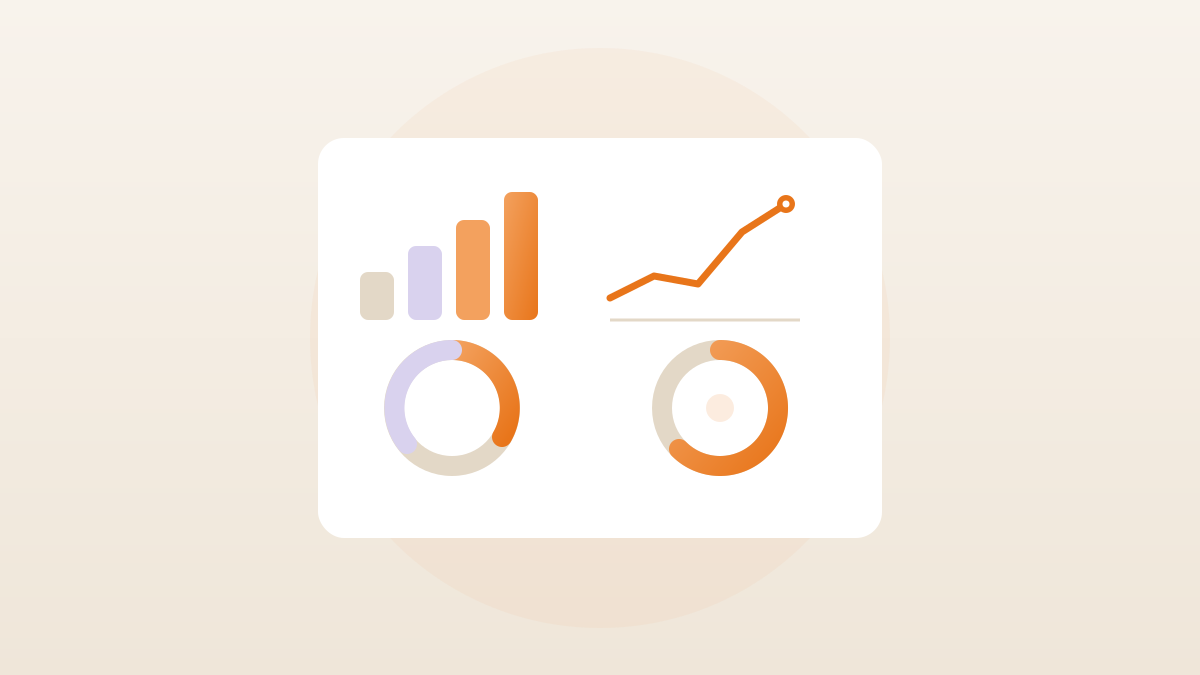
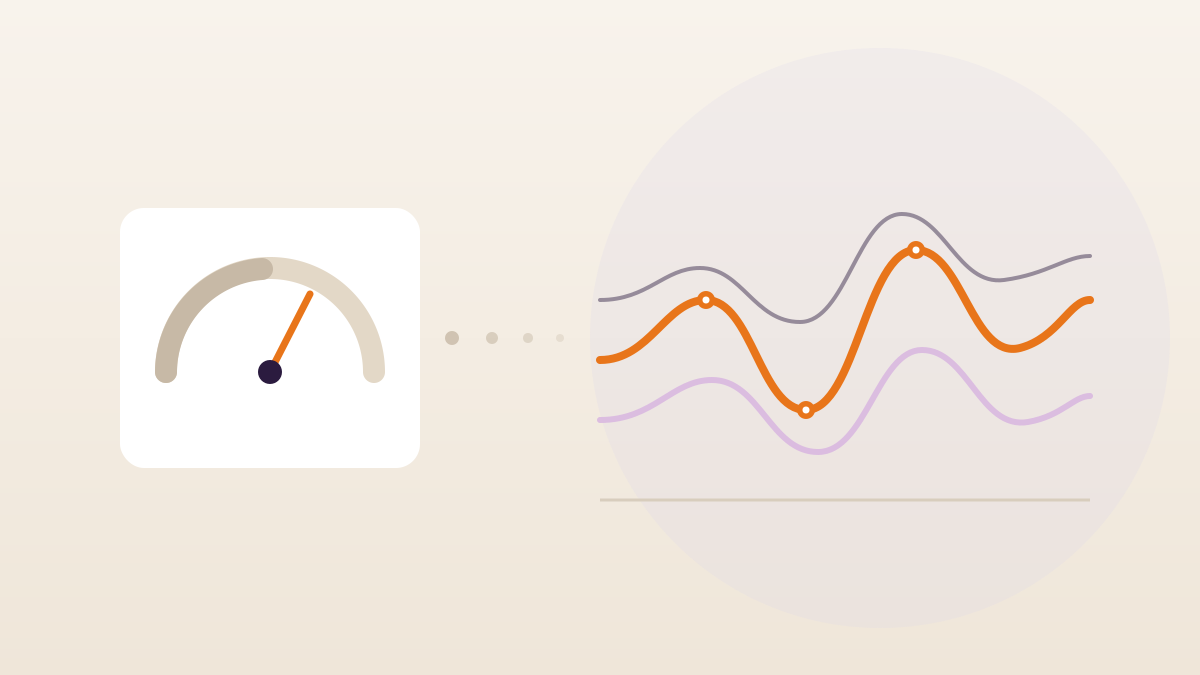
A weekly engagement dashboard in 2026 looks like three panels, one per dimension, each with the right primitive.
Attention panel. Median read time on high-priority messages, segmented by department. Acknowledgment rate on critical announcements, plotted as a line over the last 12 weeks. The 14-day acknowledgment threshold rendered as a target line. This panel tells you whether the company is paying attention to the messages that matter, this week, not last quarter.
Affect panel. Weekly sentiment score on reactions, comments, and replies in internal feeds, segmented by department. The week-over-week delta highlighted. A 0.3-unit delta threshold rendered as an alert line. This panel tells you which parts of the company are feeling differently than they did last week, which is the leading indicator the annual survey can never give you.
Commitment panel. Voluntary participation rate in non-mandatory activities: optional pulse surveys, knowledge-base contributions, peer recognition (kudos), discussion-thread activity outside required posts. Trended weekly. This panel tells you whether discretionary effort is flowing or has been withdrawn.
The three together give a richer signal than the annual composite ever did, and they have the operational property the annual score lacks: when something changes, you find out within the week.
Where this used to be expensive and is now not
The reason the industry settled on the annual survey was instrumentation cost. Measuring all three dimensions, weekly, used to require a dedicated HR analytics function, custom dashboards, and a meaningful integration budget. By 2025 the cost equation had shifted enough that mid-market companies could realistically do it; by 2026 the floor has dropped to "any platform built on the right primitives."
Two things made the shift possible:
Per-message read tracking is now a default, not a custom integration. Internal-comms platforms now ship with content-level analytics (what got read, by whom, for how long) as a baseline feature. The data is collected by the publishing flow, not by a separate observability layer.
LLM-based sentiment scoring is now cheap and accurate. A single sentiment-scored message used to cost several cents and required a vendor integration; in 2026 it costs fractions of a cent and runs as part of the content ingestion pipeline. The accuracy is good enough that weekly aggregates produce signal that correlates well with longitudinal survey-based affect measurement.
The cost curve broke, and adoption is following it: weekly affect measurement has gone from a large-enterprise luxury to something a mid-market team can stand up without a dedicated analytics function.
What this looks like in operation
Consider a 320-person logistics company that had been running annual surveys for six years. The score moved between 73 and 77 in that window. Nobody could tell what made it move.
Move it to a weekly three-panel dashboard, and the picture changes. In week 2 the warehouse team's affect score drops 0.5 points over two consecutive weeks. The operations VP walks the floor, asks what is going on, and finds the new shift-rota system is producing unworkable Friday-evening handovers. He fixes the rota; the affect score recovers by week 5. The annual survey would have surfaced this in month 9, after the team had already begun losing people.
The win is not that the dashboard is fancier. The win is that the cycle from signal to intervention drops from "next year" to "this week."
What to do with the annual survey
Do not throw it out. The annual survey is still the right instrument for the deep questions (perceived growth, manager trust, alignment with values) that need a longer-horizon view and explicit prompting to surface. The mistake is to use it as the headline engagement metric. Use it as the deep-dive instrument it always was, run it every 12-18 months, and let the weekly dashboard carry the operational load in between.
The composite metric to put on the board pack in 2026 is not the annual score. It is something we have started calling a Community Health Score: a weekly composite of the three dimensions above, calibrated to your organisation's baseline rather than a vendor's benchmarking corpus. The arithmetic is straightforward. The discipline is putting the three constituent signals next to it so the composite never gets read out of context.
That is what the Kayden Connect analytics layer is built to produce, and it is what most of the mid-market companies we talk to have started moving toward. The annual score will still exist; the operating dashboard just stops being it.
The CEO does not need a number that moves a point or two a year. The CEO needs to know which team's affect dropped this week, why, and whether somebody is investigating. Weekly measurement makes that conversation possible. Annual measurement guarantees it is too late.
See the three-panel dashboard in Kayden Connect →